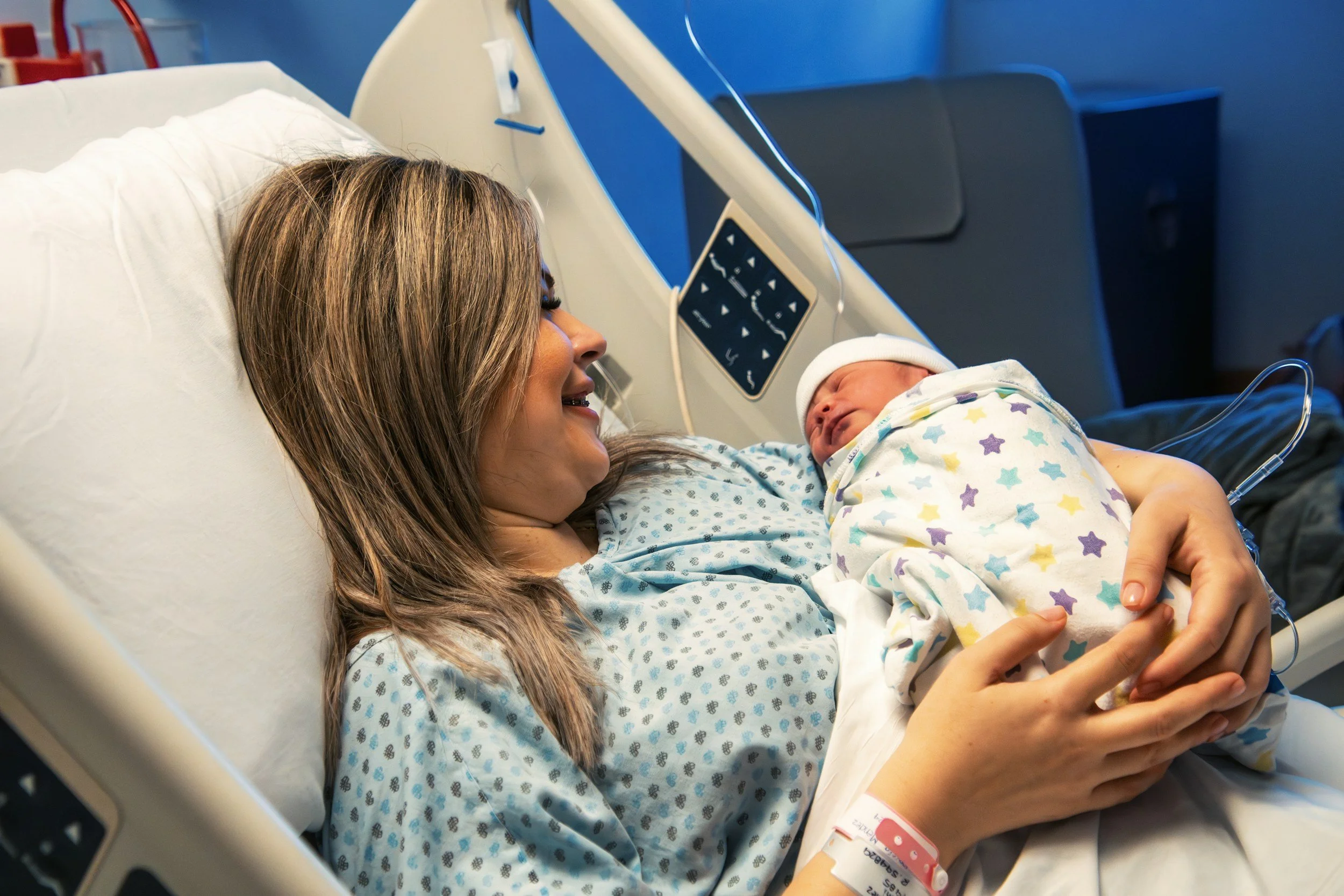
If you've had a cesarean and are hoping for a vaginal birth this time, you've probably been inundated with a whole lot of conflicting pieces of advice, super cautious providers, and a LOT of fear-based information. The truth is that an informed, well-supported parent is far more likely to have a safe and satisfying birth after cesarean, and preparation is what gets you there.
As a VBAC Link certified birth professional, I've put together this roadmap to help you prepare with confidence. Think of it as a guide. The whole point is that you make the choices that fit your body, your history, and your goals.
A note before we begin: This blog post is strictly educational and is not medical advice. VBAC is a personal decision that depends on your individual medical history. Always make your plan in partnership with a qualified provider who knows your full record.
First, the language
A few terms come up constantly in VBAC circles, and knowing them helps you advocate for yourself:
VBAC Vaginal Birth After Cesarean.
TOLAC Trial of Labor After Cesarean. This is the medical term for attempting a vaginal birth; a VBAC is a successful TOLAC.
VBA2C / VBAMC VBAC after two (or multiple) cesareans.
RCS Repeat Cesarean Section.
HBAC Home Birth After Cesarean.
You don't have to master the vocab, but recognizing these phrases makes it easier to research and to have precise conversations with your care team.
Pillar 1: Prepare your mind
The VBAC Link puts mental and emotional preparation first, not as an afterthought. So many people carrying a prior cesarean also carry unprocessed fear, disappointment, or even trauma from that birth. Walking into a new labor with that weight unaddressed can undermine everything else, even unintentionally. So it is important to work through any previous births and to release anything you are still holding on to.
Pillar 2: Prepare your body
Physical preparation gives your body the best possible conditions to labor and birth effectively.
Encourage good baby positioning. An optimally positioned baby can make labor more efficient. Common tools include daily movement, avoiding long stretches of reclining, and body-balancing work like the Body Ready Method (p.s. I’m a certified Body Ready Method professional!)
Practice your breathing. Slow, intentional, deep breathing helps with pain coping and oxygenates you and your baby. Practicing before labor means it's automatic when you need it.
Consider bodywork and movement. Prenatal chiropractic care (many look for Webster-certified providers), walking, and pelvic-floor therapy all support alignment and stamina.
Eat to nourish and heal. Good nutrition supports your pregnancy and sets you up for a stronger recovery.
Pillar 3: Get the real information
Knowing the actual numbers lets you make a decision from confidence rather than anxiety.
Understand the true risks including uterine rupture. Uterine rupture is the risk people worry about most, and it's serious, but for someone with one prior low-transverse cesarean the risk is generally low (commonly cited around 0.5–1%). Learning what actually raises or lowers that risk (scar type, spacing between pregnancies, induction methods, for example) helps you weigh it realistically instead of catastrophically.
Weigh VBAC against repeat cesarean honestly. A repeat cesarean isn't risk-free either. Major abdominal surgery carries its own possibilities of infection, longer recovery, and complications that can compound over multiple cesareans.
Know why your first cesarean happened. Understanding the reason for your prior cesarean, and whether it's likely to recur, is super important. A cesarean for a breech baby, for example, tells you little about your ability to birth a head-down baby vaginally.
Know where ACOG stands. The American College of Obstetricians and Gynecologists considers TOLAC a safe and reasonable option for most people with one prior low-transverse cesarean, and appropriate for some with two. Having this in your back pocket is powerful when a provider implies VBAC is risky.
Pillar 4: Choose a genuinely supportive provider
If there is one piece of advice I would hammer hardest, it’s this: your provider and birthplace are the single biggest factor in whether you'll actually get your VBAC. A "tolerant" provider who technically allows a TOLAC but places so many restrictions on your labor is very different from a truly supportive one. The more rigid rules attached, the less genuinely supportive the situation usually is.
Vet the whole practice and the hospital. Your favorite doctor may not be on call the day you deliver. Ask whether the entire group supports VBAC equally, and learn the hospital's VBAC policies, because those exact policies can shape your birth as much as any individual provider does.
Pillar 5: Build your support team
Hire a VBAC-trained doula. Continuous labor support is associated with better birth outcomes, and a doula who specifically understands VBAC can help you navigate decisions, advocate in the moment, and stay grounded (If you’re looking for someone in Illinois, I’m your girl!)
Prepare your partner. A partner who understands your plan, your fears, and your non-negotiables can be a fierce advocate when you're deep in labor and less able to speak for yourself.
Pillar 6: Understand interventions and make a flexible plan
Learn the interventions before you're in the room. Induction, augmentation, monitoring, and pain management all have specific considerations for a VBAC labor. Understanding interventions pros and cons means you can consent, or decline, from an informed place rather than reacting under pressure.
Write a birth plan, and hold it loosely. A clear plan communicates your priorities to your team. But it is important to remain flexible: the parents who feel best about their births are often the ones who prepared thoroughly and adapted when circumstances changed. A change of plans isn't a failure.
The bottom line
There is no list of special tricks that will help you "achieve" a VBAC. The deepest goal here isn't a vaginal birth at any cost. The goal is to walk into birth informed, supported, and in the driver's seat of your own decisions. This type of mindset protects your experience whether your birth unfolds exactly as hoped or takes an unexpected turn. The best thing you can do to prepare is heal your mind, prepare your body, learn the real evidence, surround yourself with people who trust birth, and refuse to settle for a provider who merely tolerates your goals. Do that, and whatever happens on birth day, you'll have met it on your own terms.
This guide is for educational purposes only and does not replace individualized medical advice. Discuss your specific situation with a trusted, qualified care provider.